Meet the brains behind the tongue work
Meet Ti-Sucre
A maple-taffy blob in a red tuque, with a firm birch stick and a very soft spot for syrup. Ti-Sucre appeared one March night in a Quebec sugar bush. He’s been getting attached, stealing tastes, and making a sticky name for himself ever since.
"It's sticky!"
Hard to argue with a mouthful of maple.
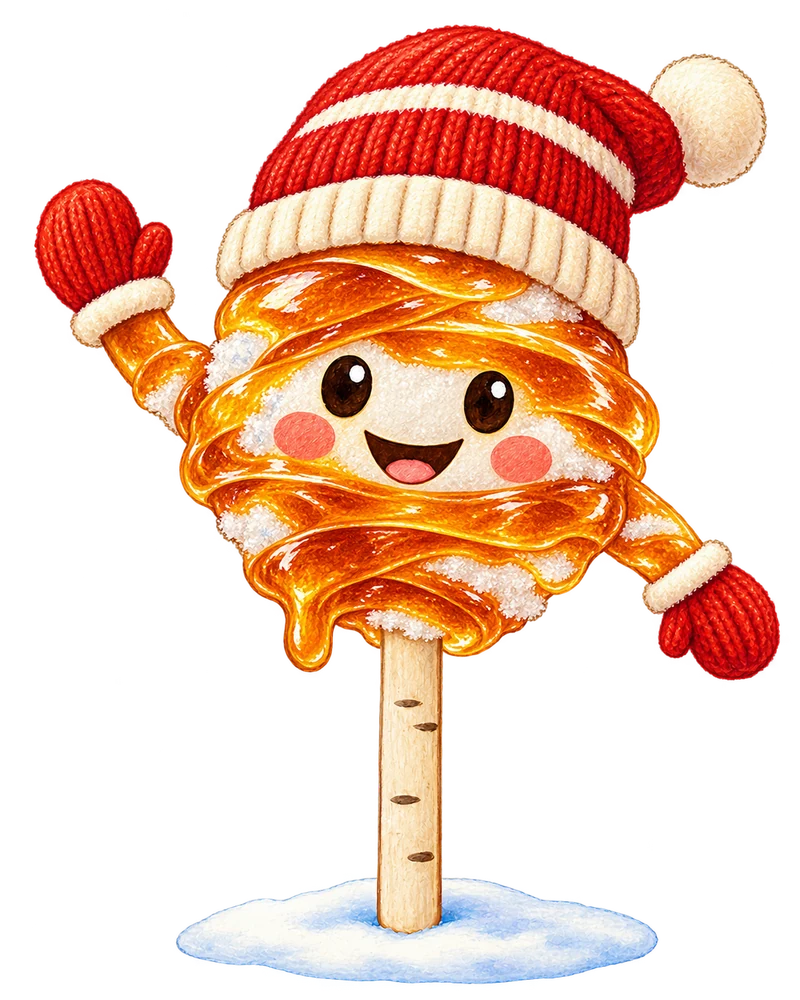
We know how to hold on
The kind of clingy you’ll invite back
Our taffy grabs the birch, holds its position, and leaves a little evidence on your lips. Cooked to 113 °C and rolled on snow, it’s a very sweet lesson in attachment. Keep a napkin handy. Your dignity is your own responsibility.
Ti-Sucre's official Stick-o-meter
Stickiness, measured in mittens lost per pop
Big claims. Sticky evidence. Absolutely no independent supervision.
Firm grip. Excellent performance.
The mitten test
Press a pop into a wool mitten and pull gently. A good grip should make letting go a little difficult. We like a pop that gets attached.
The upside-down test
Ten seconds upside down without sliding off the stick. A change of position should keep things interesting, not end them early.
The chairlift test
All the way to the top at −20 °C. Still clinging. Still satisfying. A little cold shouldn’t ruin a perfectly good performance.
Every sticky situation has a backstory
The legend of the rang 6
A late night in the bush. A steaming shack. One last hot pour. Nobody on the rang 6 agrees on every detail, but they all remember waking up to something sticky.

-
Chapter 1
A very well-tended bush
At the end of a dirt road called the rang 6, deep in the Quebec woods, there's a stand of about two thousand sugar maples and one small cabane à sucre. Every March its roof vent puffs steam from morning until well past dark.
-
Chapter 2
One last hot pour
It was the final cold night of the run. Mémère Tremblay cooked one more pot of syrup to 113 °C, carried it out by lantern light and poured it across the snow trough. The wind picked up. The lantern flickered. One ribbon of taffy rolled itself onto a birch twig, and nobody had touched it.
-
Chapter 3
Evidence of a sticky night
By morning there were little round prints leading to the woodpile, a red tuque missing from the drying line, and a very small, very sticky someone sitting on the warm edge of the evaporator, waiting for breakfast.
-
Chapter 4
A reputation that sticks
Mémère named him Ti-Sucre, "little sugar." The cousins visiting from Ontario taught him exactly one English phrase, "It's sticky!", and through a mouthful of taffy it came out "Tip Sticky." That stuck too. Everything does, around him. He's been the shack's official taste-tester ever since, and he insists every pop be rolled by hand.
Our bush gets a lot of attention
The sweetest bush in Quebec
Well-tapped trees, good wood, and long nights getting steamy. We tend this bush with both hands and a great deal of enthusiasm. The neighbours pretend they only come for the pancakes.
- Early March · Tapping
Mémère and the cousins tap the maples by hand: one spout on most trees, two on the oldest giants. Ti-Sucre supervises from inside a mitten.
- Mid-March · The first run
The first sap of the year boils down into the lightest, most delicate syrup. That golden first run goes into The Classic.
- Late March · The big run
Cold nights, hot days, and sap flowing faster than the evaporator can handle. The cabane steams all night long and the sugar parties begin.
- Early April · The last run
Late sap makes darker, bolder syrup, and that goes into Campfire. When the buds open, the syrup picks up an off, "buddy" taste and the season is done until next spring.
A good bush takes a little attention
The old giants
Deep roots. Good wood. Decades of experience. Our oldest maples still know how to deliver. We’ve never had a complaint about their staying power.
The south slope
Hot all afternoon, cold every night. Our south-facing slope knows how to tease the sap out of a tree. A little hot-and-cold treatment works wonders in the bush.
Ti-Sucre's math
Sugar makers use the Rule of 86: divide 86 by the sap's sugar percentage to get the litres of sap needed for one litre of syrup. Typical sap is about 2% sugar, so that's around 43 litres. Ti-Sucre insists ours is sweeter. He has checked. Many times.
A mouthful worth getting caught with
Thick maple. Soft folds. A firm stick to hold on to. Let it linger on your tongue, enjoy the slow finish, and try not to make a scene. We supply the taffy. The little noises are all you.
Field guide
Spotting a serial clinger
Look for a red tuque near something hot and sweet. He’s quick to get attached, generous with the samples, and hopeless at leaving well enough alone. If your mitten won’t let go, consider yourself introduced.

- Home
- A sugar bush off the rang 6, Quebec
- Made of
- 100% maple syrup
- Height
- 14 cm, stick included
- Ideal temp
- 113 °C (and not one degree more)
- Least favourite month
- July
- Hobbies
- Tobogganing, hiding in mittens, supervising the evaporator
- Catchphrase
- "It's sticky!"
Actual craft under all this flirting
Serious maple. Questionable manners.
The legend is made up. The process isn't. Every Tip Sticky pop starts in a Quebec sugar bush at the very start of spring.
- In the bush
Sap runs
When nights drop below freezing and days climb above it, sap flows from the maples into buckets and tubing.
- In the cabane
Boiled down
The evaporator turns roughly 40 litres of sap into one litre of syrup, while the whole shack fills with steam.
- On the stove
Taffy stage
The syrup is cooked again to 113 °C, the point where it sets chewy on snow instead of running off.
- In the snow
Poured & rolled
It's poured over packed snow and wound onto a birch stick by hand, the same way it's done at every sugar party.
Indigenous peoples of the Eastern Woodlands were making maple syrup and sugar long before the first sugar shack was built. Every spring run carries that knowledge forward.
Your tongue’s already asking for round two.